
aim adjustment
Headlight aim controls where the beam lands on the road. It affects nighttime visibility, glare, cutoff position, and how evenly the left and right headlights work together.
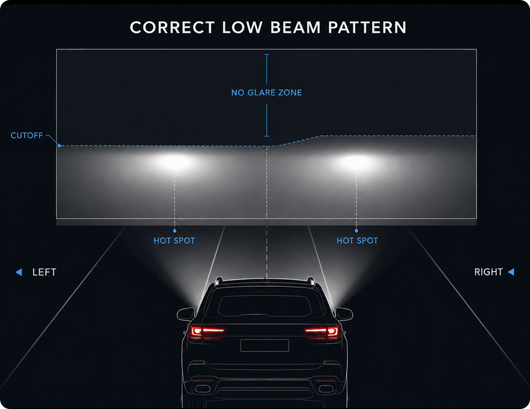
We use a state-of-the-art digital headlight aimer to measure and adjust beam placement with far more accuracy than a basic wall reference. We evaluate lamp height, cutoff position, beam pattern, side-to-side balance, and the condition of the headlight assembly before making adjustments.
The goal is to place usable light where the driver needs it while keeping glare under control for everyone else on the road.
Headlight Installation Should Include Aim Verification
A headlight replacement is not finished when the assembly is bolted in and the lights turn on.
The beam still needs to be verified. Even small changes in headlight position, mounting angle, vehicle height, or internal alignment can change where the light lands on the road. NHTSA has stated that headlamp replacement and vehicle loading can alter headlamp aim and may contribute to glare complaints.
Some shops are equipped to replace the headlight assembly, but not equipped to properly verify headlight aim. When aim is not checked, the customer may leave with new headlights that still perform poorly — or headlights that create glare for other drivers.
When Headlight Aim Adjustment Is Needed
Headlight aim should be checked when the position of the headlight, the vehicle ride height, or the internal beam alignment may have changed.
This most commonly applies after:
- Headlight assembly replacement
- HID or LED upgrades
- Projector retrofit work
- Suspension lowering or lifting
- Collision repair where the headlights, mounting points, or front-end structure were affected.
Aim adjustment is also recommended when the headlights appear too low, too high, uneven from side to side, or when other drivers are flashing their high beams at you.
More Than Turning an Adjustment Screw
Proper headlight aiming starts before the adjusters are touched.
The technician sets tire pressure to factory specification and allows the suspension to settle so
the vehicle sits at its normal ride height Then the headlight height, beam cutoff, vertical aim,
and side-to-side balance are measured using a state-of-the-art digital headlight aimer.
This controlled process verifies where the light is actually landing instead of relying only on a
visual wall reference.
Industry standards recognize headlight aim as a measurable inspection process. SAE J599 is
intended for inspection and maintenance of lighting equipment on vehicles in use, and NHTSA
research describes SAE J599-based headlamp aim inspection by evaluating the low-beam cutoff location on a screen.
What We Check Before Adjusting
Before adjusting the headlights, we inspect the beam pattern and the physical condition of the lighting system.
We look for distorted cutoff, scattered light, weak projector output, incorrect HID or LED positioning, loose mounts, broken adjusters, aftermarket headlight alignment issues, previous installation problems, or internal optical issues inside the headlight assembly.
Aim adjustment can correct beam placement, but it cannot fix a damaged or poorly designed optical system. If the beam pattern itself is defective, the headlight may need repair, replacement, retrofit correction, or internal alignment work before it can be aimed properly.
A Dedicated Automotive Lighting Facility
Most repair shops treat headlight aim as a small adjustment. At Vivid Headlight, it is part of a complete lighting evaluation.
We specialize in automotive lighting, including headlight restoration, lens replacement, moisture repair, broken tab repair, assembly replacement, HID and LED upgrades, projector retrofits, wiring, diagnostics, and lighting integration.
That gives us the ability to look at the full system instead of guessing from one symptom.
Vehicle lighting is a system, not a single service.
FREQUENTLY ASKED QUESTIONS
Do replacement headlights need to be aimed?
Yes. After headlight assembly replacement, aim should be verified because the new assembly may sit differently than the original. NHTSA has stated that headlamp replacement can alter headlamp aim.
Do HID or LED upgrades need aim adjustment?
Yes. HID and LED upgrades can change beam intensity, cutoff behavior, and glare. The beam should be checked after the upgrade.
Can aftermarket headlights be aimed correctly?
Some can. Some aftermarket headlights produce a clean beam pattern and can be aimed properly. Others have poor optics or uneven output that cannot be corrected by aim alone.
Why are other drivers flashing me?
The headlights may be aimed too high, the beam may be scattered, or the lighting system may not be producing a controlled pattern. We can inspect the beam to determine the cause.
Not Sure If Your Headlights Are Aimed Correctly?
If your headlights look too low, too high, uneven, scattered, or weak at night, we can evaluate the beam pattern and adjust the aim using digital headlight aiming equipment.
We typically respond within the same day.